

What Are A2L Refrigerant Regulations? A Complete Guide to the 2025 Rules, Meaning & 2026 Outlook
If you looked into replacing your AC this past year, or you are a facility manager overseeing a commercial retrofit in late 2025, you have likely noticed a major shift: R-410A equipment is rapidly disappearing, replaced by new A2L refrigerant systems.
But for many, the term "A2L" is still just a confusing acronym. Is it a brand name? A chemical formula? And why are these A2L refrigerant regulations suddenly the law of the land?
This guide breaks down exactly what is A2L refrigerant, the regulations driving this change, and what the new safety standards mean for homeowners and businesses as we head into 2026.
What Is A2L Refrigerant?
In the simplest terms, what is an A2L refrigerant? It is the latest generation of refrigerant designed to replace the older, high-polluting R-410A (and the legacy R-22 before it).
Unlike previous transitions that focused solely on saving the ozone layer, the current A2L refrigerant regulations are about lowering the "Global Warming Potential" (GWP) of the gas inside your AC. New A2L refrigerant options, such as R-454B (common in homes) and R-454A (common in commercial refrigeration), are chemically designed to absorb significantly less heat in the atmosphere if they leak.
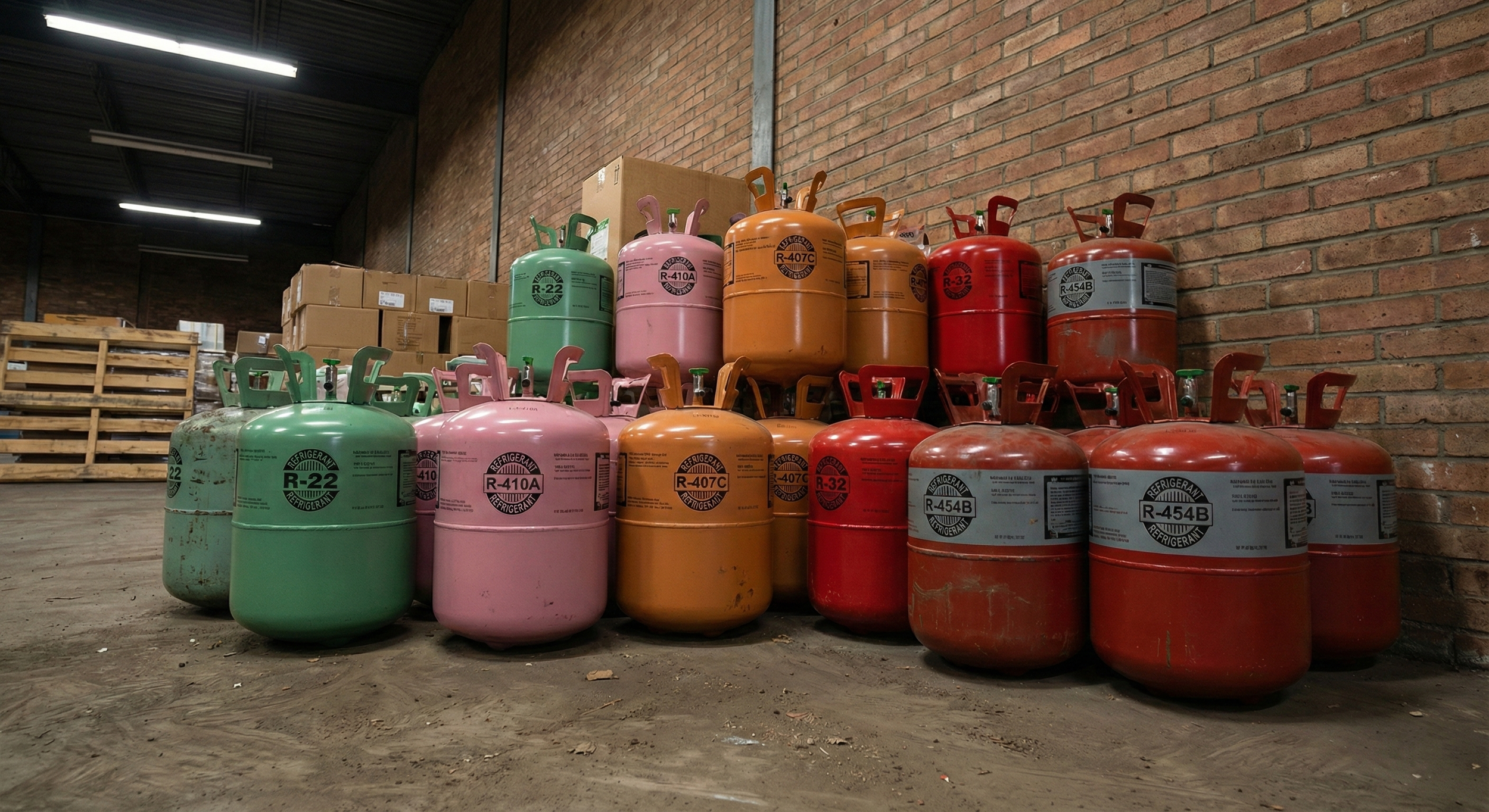
A2L Refrigerant Cylinders (red) along with A1 Refrigerant Cylinders (green, orange, and pink)
But the name "A2L" isn't just a random code—it is a specific safety classification that tells you exactly how the refrigerant behaves.
The A2L Meaning: Decoding the Safety Class
To understand what are A2L refrigerants, you have to look at the safety rating system used by ASHRAE (the global governing body for HVAC). The A2L meaning breaks down into three simple parts:
1. "A" = Non-Toxic
The "A" stands for Non-Toxic. Just like the old R-410A (which was class A1), A2L refrigerants are not poisonous to humans in normal concentrations. You do not need a gas mask to be in the same room as a unit.
2. "2" = Flammable
This is the main difference that has people asking what is A2L refrigerant. The "2" indicates that it falls into the "Flammable" category. However, it is crucial to note that it is not highly explosive like propane (which is Class A3). It sits in a middle ground—technically flammable, but stable.
3. "L" = Low Burning Velocity
The "L" is the most important part of the A2L meaning. It stands for Low Burning Velocity. This means that if the refrigerant does ignite, the flame spreads incredibly slowly—typically less than 10 centimeters per second. It is "lazy" and difficult to sustain. In fact, it is so hard to light that you generally need a direct, high-energy flame to get it to burn at all. It will not ignite from a simple static spark or a hot surface like a lightbulb.
Why the Regulations Changed
You might be wondering: if the old stuff was non-flammable, why did the EPA mandate a switch to a new A2L refrigerant that has any flammability at all?
The answer is balance. To create a refrigerant that cools effectively without destroying the environment, chemists had to change the molecular structure.
Old R-410A: Non-flammable (A1), but had a massive Global Warming Potential (GWP) of 2,088.
New A2L (R-454B): Mildly flammable (A2L), but drops that GWP down to 466.
That trade-off—accepting a tiny, manageable amount of flammability in exchange for a massive reduction in pollution—was the core reason for the A2L refrigerant regulations that took full effect in 2025.
New Safety Standards: Residential vs. Commercial
Because the question "what is A2L" leads to safety concerns, regulators like the EPA and ASHRAE have engineered new safety features directly into the building codes. However, the approach differs depending on the size of the system.
For Homeowners (Residential Systems)
If you bought a new central AC this year, it likely included:
Leak Detection Sensors: A built-in "nose" inside the air handler that constantly sniffs for leaks.
Automatic Mitigation: If a leak is detected, the system automatically shuts down the compressor and turns on the blower fan to dissipate the gas, preventing it from ever reaching a concentration where it could ignite.
For Facility Managers (Commercial/Industrial)
In commercial settings—like supermarkets or cold storage warehouses—the A2L refrigerant regulations are stricter due to the larger volume of refrigerant.
Machinery Rooms: Under ASHRAE Standard 15, mechanical rooms housing A2L chillers or racks must have industrial-grade leak detection systems.
Ventilation Protocols: These sensors are hard-wired to emergency exhaust fans. If a leak is detected (typically at 25% of the Lower Flammability Limit), the fans ramp up immediately to flush the room.
Charge Limits: You will see strict limits on how much new A2L refrigerant can be in a single circuit, especially for systems that run through public corridors or lobbies.
Looking Ahead: What to Expect in 2026
As 2025 comes to a close, the industry has largely adapted to the manufacturing ban. However, 2026 brings its own set of critical deadlines that will impact how systems are installed and serviced.
1. The "Sell-Through" Deadline
While manufacturers stopped building R-410A residential units back in January 2025, distributors have been allowed to sell their remaining stock throughout the year. January 1, 2026 marks the installation cutoff in many jurisdictions. After this date, you generally cannot install a brand-new, standalone R-410A condenser that was manufactured before the ban (though exceptions exist for repairing specific components).
2. Commercial Transitions Accelerate
The commercial sector operates on a delayed timeline. For Variable Refrigerant Flow (VRF) systems—common in hotels and office buildings—manufacturing of high-GWP units typically stops on January 1, 2026, with installation allowed until January 1, 2027. Facility managers have one final year to complete R-410A projects before A2L becomes the mandatory standard for these complex systems.
3. Rising Costs for Old Refrigerant
As the supply of virgin R-410A dwindles, the market for reclaimed refrigerant will explode in 2026. Homeowners with leaking older systems may find that a "gas-and-go" top-off becomes significantly more expensive, making a full system replacement with new A2L refrigerant a more attractive financial option.
Summary: What Is A2L?
So, when someone asks what is A2L, the answer is simple: It is the new, eco-friendly standard for cooling. It is a class of refrigerants that are non-toxic, mildly flammable, and difficult to ignite, designed to meet the strict A2L refrigerant regulations of the modern era.
While the A2L meaning might sound technical, the result is straightforward. The new A2L refrigerant systems running today—whether in your backyard or on a supermarket roof—are cleaner, more efficient, and rigorously tested to be safe.