

Central Air Conditioner Troubleshooting: The "Split System" Isolation Strategy
The "Divide and Conquer" Diagnostic Method
When a central air conditioner fails, most homeowners (and green technicians) make a fatal mistake: they immediately walk outside to the condenser, unscrew the panel, and start staring at wires.
This is the "shotgun approach"—guessing at parts hoping something sticks. But a professional diagnostician uses a logic-based approach. Because your AC is a "split system," your troubleshooting should be split, too.
Effective central air conditioner troubleshooting isn't about knowing every component; it’s about knowing where the chain of command broke. Is the failure inside the house (the Air Handler/Furnace) or outside (the Condenser)?
This guide will teach you how to "split the diagnosis," focusing on the often-overlooked indoor electrical faults that mimic outdoor failures.
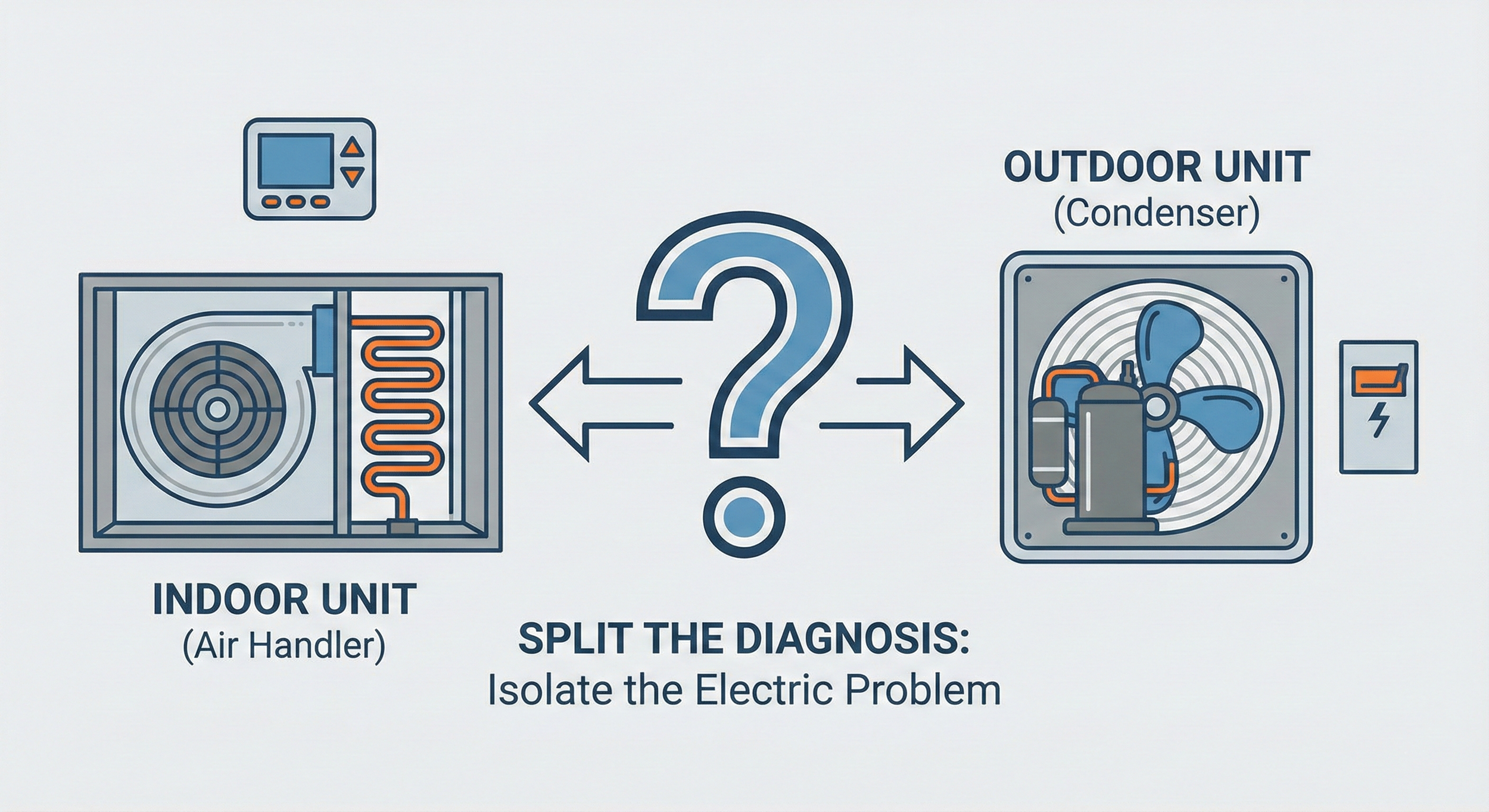
Central air conditioner troubleshooting diagram showing how to isolate an electric problem between the indoor air handler and outdoor condenser.
Phase 1: The Thermostat "Handshake"
Before checking high-voltage components, you must verify the low-voltage "handshake." The thermostat is the commander. It sends a 24-volt electrical signal to both the indoor fan and the outdoor compressor simultaneously.
The "Fan On" Isolation Test: This is the single most important step in isolating an electric problem.
Go to your thermostat.
Switch the mode to "OFF."
Switch the Fan setting from "AUTO" to "ON."
Listen and feel for airflow at your return vent.
This simple toggle splits the system in half for you.
Phase 2: Scenario A - The Indoor Fan Does NOT Run
If you switch the fan to "ON" and hear silence, stop looking at the outdoor unit. You have successfully isolated the fault to the Indoor Unit (Air Handler or Furnace).
Even if your outdoor unit is also dead, it is likely a symptom, not the cause. Most modern systems act on an "interlock"—if the indoor low-voltage is dead, the outdoor unit will never get the signal to turn on.
1. The "Door Switch" Trap
The most common "embarrassing" fix for technicians.
The Component: A small safety switch located on the door panel of your furnace or air handler.
The Fault: If the door panel isn't seated perfectly tight (often after a filter change), the switch pops open and kills all 24-volt power to the entire system—indoor and outdoor.
The Fix: Locate the air handler (attic, closet, or basement). Ensure the blower door is pressed firmly against the cabinet. If the system kicks on, you’ve found your problem.
2. The Indoor High-Voltage Check
If the door is closed and the fan still won't spin, checking the breaker panel is the next logical step. However, ensure you are checking the correct breaker.
The Split: You likely have two AC-related breakers. One labeled "AC/Condenser" (double pole) and one labeled "Furnace/Air Handler" (often single pole).
The Diagnosis: If the "Furnace" breaker is tripped, you have a short in the blower motor or a grounded element. If it is not tripped, but the fan won't run, the issue is likely the Indoor Blower Capacitor or the Control Board.
Phase 3: Scenario B - The Indoor Fan Runs, But Air is Warm
If the fan turns on, you have confirmed that the indoor unit has power, the transformer is working, and the thermostat is sending signals. You have now isolated the electric problem to the Outdoor Unit or the communication line leading to it.
1. The "Communication Line" Sever
Before you assume the outdoor unit is broken, check the wire that connects the two halves of your system.
The Visual Check: Go outside. Look at the brown thermostat wire entering the condenser. This is a notorious spot for damage from weed whackers or dog chews.
The Logic: If this wire is cut, the indoor unit will blow air all day long, but the outdoor unit will sit in silence because it never received the "GO" signal.
2. The Float Switch Lockout
This is a unique scenario where the indoor fan runs, but the outdoor unit is dead.
The Mechanism: Many installers wire a condensate safety switch to break only the yellow (Y) wire going outside.
The Symptom: The thermostat calls for cooling. The indoor fan blows. The outdoor unit does nothing.
The Diagnosis: Check your drain pan. If it is full of water, the switch has "opened" the circuit to the outdoor unit to stop it from producing more water. Vacuum the line, and the outdoor unit will likely roar back to life.
Phase 4: Verifying the "Call" (The Multimeter Test)
If you are comfortable using a multimeter, you can mathematically prove where the split is without guessing.
Locate the Terminal Board on your furnace/air handler (where the thermostat wires connect).
Set Meter to Volts AC.
Test R to G: (Red to Green). You should see 24V. This confirms the thermostat can turn on the fan.
Test Y to C: (Yellow to Common).
Result 0V: The thermostat is not sending the signal. The problem is the thermostat.
Result 24V: The indoor unit is sending the signal out to the condenser. If the outdoor unit isn't running, the problem is definitively located outside (bad contactor, capacitor, or disconnect).
Note: If your diagnosis leads you outside to a humming unit or a non-spinning fan, refer to our guide on [Outdoor Condenser Troubleshooting Steps] to inspect the capacitor and contactor specifically.
| Symptom / Observation | The "Split" Diagnosis | Likely Electric Problem | First Action to Take |
|---|---|---|---|
| Indoor Fan Won't Turn On (Thermostat set to "Fan On") |
INDOOR UNIT (Air Handler/Furnace) |
No Power, Tripped Breaker, Open Door Switch | Check "Furnace" Breaker & Ensure Blower Door is closed tight. |
| Indoor Fan Runs + Outdoor Unit is Silent |
COMMUNICATION / SAFETY (Signal isn't reaching outside) |
Tripped Float Switch, Cut Thermostat Wire | Check Drain Pan for water. Check low-voltage wires outside for damage. |
| Indoor Fan Runs + Outdoor Unit Hums |
OUTDOOR UNIT (High Voltage Component) |
Bad Dual Run Capacitor, Seized Fan Motor | STOP. Turn off power immediately. Test Capacitor or Contactor. |
| Indoor Fan Runs + Outdoor Fan Runs (Warm Air) |
SYSTEM PERFORMANCE (Non-Electrical) |
Clogged Air Filter, Dirty Coils, Refrigerant Leak | Change Air Filter. Wash outdoor coils. |