

Must-Have Electrical Troubleshooting Tools for HVAC Techs: The Diagnostic Loadout
The Difference Between Guessing and Knowing
You can memorize every schematic and master the "hopscotching" method, but if your tools lie to you, you’re dead in the water.
We’ve talked before about the Advanced Electrical Troubleshooting Mindset, where we moved away from being "parts changers" to becoming true diagnosticians. But a mindset is only as good as the data it receives. If your meter reads 24V when there’s actually a ghost voltage, or if your amp clamp can’t catch the split-second inrush of a locked rotor, you aren't diagnosing—you're guessing.
To rank among the top technicians, your tool bag needs to be as sharp as your skills. This guide covers the essential electrical troubleshooting tools and HVAC electrical components testing gear that separate the pros from the amateurs.
Note: We only recommend tools we trust and use in the field. This post contains Amazon affiliate links; we earn a commission on qualifying purchases at no additional cost to you.
1. The Multimeter: Your Primary Weapon
The digital multimeter (VOM) is the heartbeat of your diagnostic kit. However, grabbing a cheap meter from the hardware store won't cut it for HVAC applications. You are dealing with inductive loads, variable frequency drives (VFDs), and harsh environments.
Must-Have Features:
True RMS (Root Mean Square): Modern HVAC systems use inverters and VFDs that create non-sinusoidal waveforms (dirty power). A standard averaging meter will give you false readings on these components. True RMS is non-negotiable for accuracy on high-efficiency equipment.
Auto-Ranging with Manual Override: Speed is key, but sometimes you need to lock a range to catch a fluctuating signal.
LoZ (Low Impedance) Mode: This is the hardware solution to the "ghost voltage" problems we discussed in our Ghost Wiring Guide. A standard meter has high impedance and might read 24V on a dead wire due to induction from nearby live wires. LoZ mode puts a small load on the circuit, collapsing ghost voltage and showing you the real state of the wire.
Field-Tested Recommendations
Top Pick: Fluke 116 HVAC Multimeter Why: It is specifically designed for HVAC. It includes a built-in thermometer and a dedicated microamps setting for flame sensors, eliminating the need to carry a separate temp gun or adapter.
Solid Alternative: Klein Tools CL800 Why: A budget-friendly workhorse that includes the critical LoZ mode and is rugged enough for daily van abuse.
2. The Amp Clamp: Catching the Invisible Spikes
Testing a compressor or blower motor isn't just about running amps (RLA). The most critical moment for a motor is startup, and standard meters are too slow to see it.
Inrush Current Capability: When a compressor starts, it pulls a massive spike of current for a fraction of a second. A standard "Max Hold" feature misses this. You need a dedicated Inrush function that captures that millisecond surge to diagnose hard-start kits or tight compressors.
Microamps (µA): Essential for testing flame sensors on furnaces. If your clamp meter doesn’t read DC microamps, you’ll be carrying a second meter just for heating season.
Field-Tested Recommendations
Industry Standard: Fieldpiece SC440 or SC680 Why: These are arguably the most popular clamp meters in the trade for a reason. They feature a swivel head (great for tight condensers), a magnet strap, and excellent Inrush capturing capabilities.
Compact Choice: Fluke 323 True RMS Clamp Meter Why: If you prefer a smaller meter just for amps, the 323 is bulletproof, though it lacks some of the advanced HVAC-specific features of the Fieldpiece.
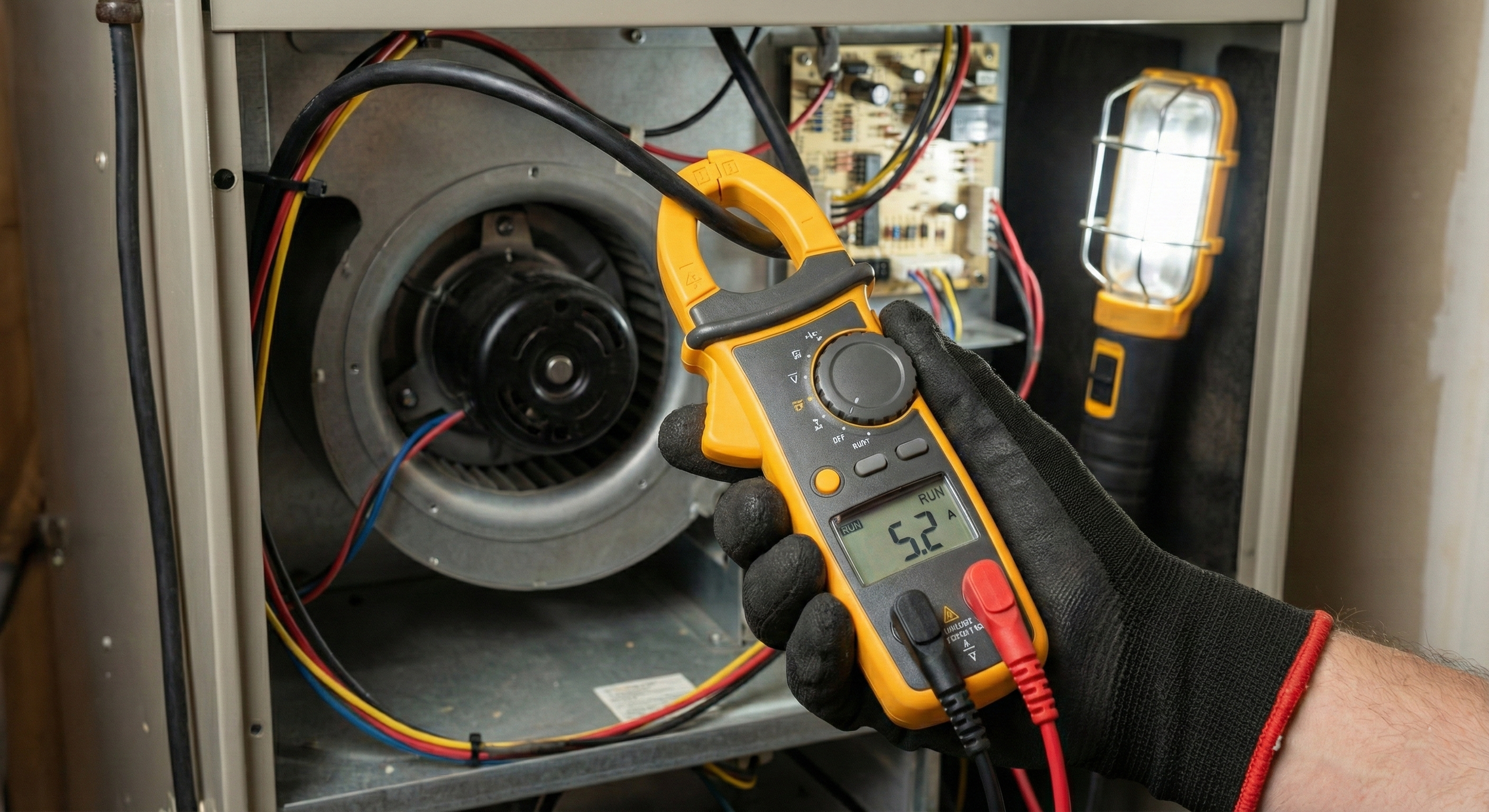
HVAC technician using an electrical troubleshooting amp clamp to test blower motor current.
3. Leads and Probes: The Interface
Your meter is useless if you can’t make a solid connection. The stock leads that come with most meters are often stiff PVC that cracks in the cold.
Silicone Test Leads: Upgrade to silicone immediately. They remain flexible in freezing attics and won't fight you when you're trying to position your meter.
Needle-Tip Probes: Modern control boards use tiny Molex plugs that standard probes destroy. Needle tips allow you to back-probe connectors non-destructively to read voltage while the component is running.
Magnetic Hangers: If you are holding your meter, you have one less hand to work with. A magnetic strap lets you hang the meter on the unit, keeping both hands free for safe testing.
Field-Tested Recommendations
Best Upgrade: Fieldpiece ADK7 Deluxe Silicone Test Lead Kit Why: These silicone leads don't stiffen in the cold, and the kit comes with alligator clips and needle tips specifically for back-probing sensors.
Pro Safety: Fluke TL224 SureGrip Silicone Leads Why: Known for their "SureGrip" surface, these are less likely to slip out of your hands when you're sweating in a hot attic.
4. Component-Specific Diagnostic Tools
Beyond the standard meter, specific HVAC electrical components require specialized tools to verify their health.
The Capacitor Tester (or MFD Function)
Many techs rely on the "hum test" or visual inspection for capacitors. This is dangerous and inaccurate. You need a meter capable of measuring Microfarads (MFD). A capacitor can look brand new but be weak enough to overheat a compressor motor.
The Megohmmeter ("Megger")
You want to stop callbacks? Start using a Megger. A standard ohm meter tells you if a winding is broken; a Megger tells you if the insulation is failing before it shorts out. It shoots high voltage (500V or 1000V) through the windings to stress-test the insulation. It’s the ultimate preventative maintenance tool for compressors.
Phase Rotation Meter
For those working on commercial 3-phase equipment, a phase rotation meter is critical. Hooking up a scroll compressor backwards (running in reverse) will kill it in minutes. This tool verifies the sequence (L1, L2, L3) before you flip the breaker.
Field-Tested Recommendations
The Compressor Saver: Supco M500 Insulation Tester Why: It’s the "classic" affordable megohmmeter. It’s simple, effective, and tells you if a compressor is grounded or failing in seconds.
Commercial Essential: Extech 480400 Phase Sequence Tester Why: A simple, rugged device that prevents costly mistakes when wiring up 3-phase commercial rooftop units.
My Favorite Pick: Fieldpiece SMG5 Standalone Digital Megohm Meter Why: This meter is significantly cheaper and simpler. While high-end models are expensive "all-in-one" multimeter/megger combos, the SMG5 is a standalone, budget-friendly tool meant to be paired with your daily meter, not replace it.
The professional and expensive pick: FLUKE 1587 FC 2-in-1 Insulation Multimeter Why: The Fluke 1587 FC replaces the need for two separate tools by combining a digital insulation tester with a full featured True-RMS multimeter. While the $800+ price tag is significant, it pays for itself through industrial grade CAT IV 600V safety, "bulletproof" durability, and Fluke Connect® wireless data logging. It is the smarter investment for professionals because it streamlines your toolkit while offering the advanced protection and connectivity that cheaper meters simply cannot match.
5. Safety Gear: The Non-Negotiables
We previously covered the Safety Guide to Residential HVAC Troubleshooting, but your tool bag needs physical safety gear, not just rules.
Non-Contact Voltage Tester (NCV): Treat this as a "quick check," not a life-saving device. It’s great for a preliminary scan, but always verify with your leads before touching a conductor.
Insulated Screwdrivers: When tightening terminals on a live diagnostic (which you should avoid whenever possible), an insulated shaft protects you from arc flash if your hand slips.
Field-Tested Recommendations
Quick Check: Fluke 1AC-II VoltAlert Why: The industry standard "tick tracer." It’s reliable and fits right in your shirt pocket for immediate checks.
Hand Protection: Wiha Insulated Screwdriver Set Why: German-engineered and rated for 1000V. The insulation is slim enough to fit into tight breaker terminals where other insulated drivers get stuck.
Summary: Invest in Accuracy
Your tools are an extension of your reputation. If you show up with inadequate gear, you are likely to misdiagnose the issue, leading to replaced parts that weren't broken and callbacks that cost you money.
Equip yourself with tools that handle True RMS, Inrush Current, and Low Impedance voltage checks. Once you have the right loadout, use it to follow our Definitive HVAC Electrical Troubleshooting Guide to systematic success.
For a visual breakdown of how "ghost voltage" can fool a standard meter (and why LoZ is critical), check out this video demonstration: Ghost Voltage Explained - Master Samurai Tech
This video provides a practical, real-world demonstration of the "Ghost Voltage" phenomenon mentioned in the article, showing exactly why the LoZ (Low Impedance) meter function is a mandatory tool for accurate diagnostics.