

How to Get Into HVAC: Best Electrical Training & The Road to a Union Apprenticeship
So, You Want to Be an HVAC Technician?
If you are looking for a career that offers six-figure earning potential, cannot be outsourced to AI, and lets you work with your hands, you have found it. But if you have tried Googling "how to become an HVAC tech," you probably hit a wall of conflicting advice.
"Just go knock on doors!"
"You have to go to college for two years!"
"Join the union immediately!"
The truth is, the "best" path isn't a single door—it's a ladder. And the biggest rung on that ladder is mastering HVAC and electrical skills.
While the Union Apprenticeship is widely considered the gold standard for a lifelong career, you can rarely just walk in off the street and get accepted. It is highly competitive.
In this guide, we are going to map out the "Golden Path" Strategy. This is the step-by-step roadmap to building a resume that makes Union recruiters beg you to join, starting with the right electrical troubleshooting training.
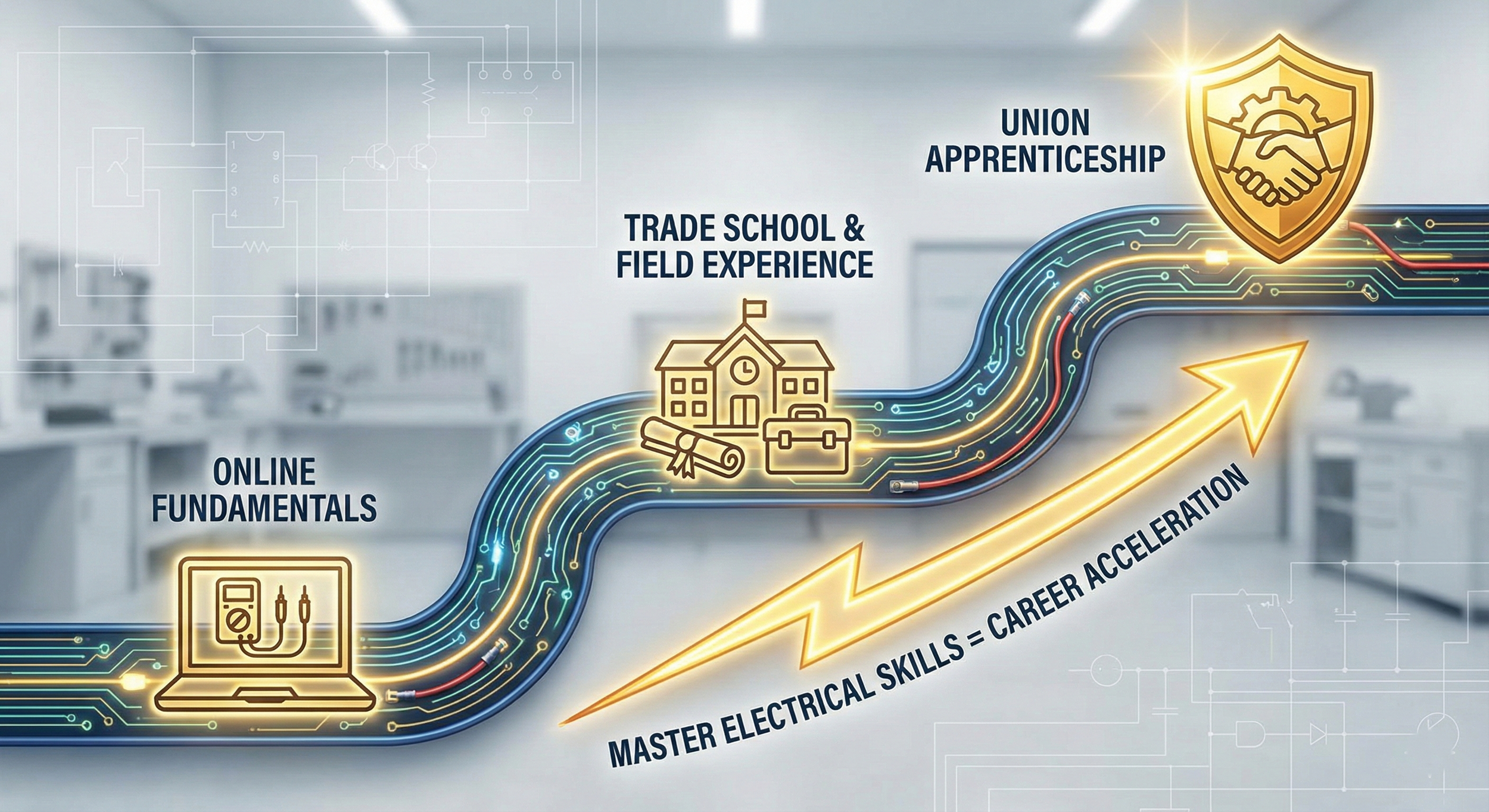
HVAC career path roadmap showing the progression from online HVAC electrical training to a Union Apprenticeship
The "Golden Path" Strategy
Most people try to jump straight to the finish line. Instead, we recommend a strategic approach that builds your skills layer by layer.
Phase 1: Test the Waters (Low Risk, High Reward)
Before you sign a loan for a $20,000 trade school, you need to know if this trade is actually for you. Do you understand the logic of a circuit? Does the idea of troubleshooting a furnace excite you?
Start with one or two affordable HVAC electrical training courses online. This allows you to:
Validate your interest: Ensure you actually like the material before committing years of your life.
Learn the lingo: When you do interview for schools or jobs, you won't sound like a total greenhorn.
Master the basics: Learn safety, tool usage, and basic electrical theory on your own time.
Start Here: The HVAC Reaper Online Course Our course is designed specifically for this phase—it gives you the "pre-apprenticeship" knowledge and electrical troubleshooting training you need to excel in formal schooling.
Phase 2: The Foundation (Trade School or Junior College)
Once you are committed, this is where you get your formal education. Most Union programs require some trade school experience to even be considered for an interview. They want to see that you are disciplined and have a baseline mechanical aptitude.
Community College (Best Value): Programs like those at STLCC or local junior colleges are often affordable and thorough.
Trade Schools: Institutions like Lincoln Tech are faster but more expensive.
Goal: The piece of paper is important, but the real goal here is getting your EPA 608 Universal Certification and solidifying your HVAC and electrical fundamentals.
Phase 3: The "Gap Years" (Non-Union Experience)
This is the step most people skip, and it costs them. While waiting for a Union opening, get a job immediately.
Working for a non-union residential or light commercial company is the boot camp of the industry. You will run endless service calls, crawl in hot attics, and deal with frustrated homeowners.
Why do this? You build "field armor." You learn how to talk to customers, how to drive a service van, and how to apply your electrical troubleshooting training under pressure.
The Benefit: When you finally apply to the Union, you aren't just a student with a book; you are a technician with verifiable field hours.
Phase 4: The End Game (The Union Apprenticeship)
This is the summit. Organizations like the United Association (UA) offer the highest level of training, pension protections, and pay scales in the industry.
Because you followed this path—you have the online certs, the trade school diploma, and 1–2 years of actual field experience—you are now a top-tier candidate. You aren't a gamble; you are a sure thing.
Why the Union Apprenticeship is the Goal
You might ask, "If I'm already working in Phase 3, why switch?"
The Education: Union training centers (JATCs) are often funded by multi-million dollar trusts. They teach advanced systems—VRF, Chillers, Industrial Refrigeration—that most residential companies can't touch.
The Benefits: We are talking about fully paid health insurance for your family and a defined pension plan.
The Safety: Unions prioritize technician safety over speed. In the non-union world, you might be pressured to work "live" or skip safety steps. In the Union, you have a brotherhood watching your back.
Read more about safety standards in our Residential HVAC Electrical Troubleshooting Safety Guide.
How to Prepare for the Electrical Curveball
Whether you are applying for a non-union job or sitting for your Union entrance exam, the number one thing that filters candidates out is Electrical Knowledge.
Most "green" techs can change a filter. Very few can read a wiring diagram or understand why a contactor is chattering.
If you want to fast-track your entry into the trade, become the guy who understands electricity. That is the skill that gets you hired. High-quality HVAC electrical training is the investment that keeps you employed during the slow season.
Ready to start your journey?
Get Skilled: Check out our HVAC Reaper Online Training to start learning today.
Get Informed: Read our guide on The Advanced Electrical Troubleshooting Mindset.
Get Hired: Use your new skills to land that apprenticeship.
Union vs Non-Union? We discuss the differences! This video features an interview with a UA training director who explains exactly why Union training sets the standard for the industry and what they look for in new apprentices.