

Solving "Ghost" Wiring Issues: Troubleshooting Intermittent HVAC Electrical Failures
You get the call: "My AC runs for ten minutes and then trips the breaker." You arrive, reset the breaker, and the unit runs perfectly for an hour. You check the amps, the pressures, and the capacitor. Everything is within spec. You leave.
Two hours later, the customer calls back. "It happened again."
These are "Ghost" electrical issues intermittent failures caused by vibration, thermal expansion, or hidden insulation damage. They are the most frustrating wiring issues to diagnose because they rarely present themselves while the system is off or while your meter leads are attached.
If you want to stop the callbacks and fix the unit the first time, you have to stop looking for static failures and start hunting for dynamic ones.
Stop: Is It a Static or Dynamic Short?
Before you start tearing apart the condenser, you need to know what kind of ghost you are hunting.
Dynamic Short (This Guide): The problem happens while the unit is running, shaking, or heating up. This is usually caused by vibration or "rub outs" in the equipment itself.
Static Short (Hidden): The fuse pops immediately, or randomly even when the unit isn't vibrating? You might have a nail through a wire or a hidden short behind the drywall.
Read This First: If you suspect your issue is hidden inside the walls or involves the thermostat wiring specifically, check out our guide on [Troubleshooting Electrical Wiring: Tracing Hidden Low Voltage Shorts in Walls].
If you are sure the problem is in the equipment and only happens during operation, keep reading.
The Science of the "Rub-Out"
The most common cause of a ghost short is a "rub out." An HVAC unit is a high-vibration environment. Compressors shake, condenser fan motors rattle, and blower wheels vibrate.
Over time, unsecured high-voltage wires rub against copper refrigerant lines, sheet metal edges, or even other wires. Eventually, the vibration wears through the PVC insulation, exposing the copper conductor.
Why it’s a "Ghost": Often, the wire only shorts out when the unit vibrates at a specific frequency or when the wire heats up and expands just enough to touch the metal chassis. When the unit shuts off, the vibration stops, the wire relaxes, and the short disappears. A standard continuity test will show the wire is fine because, at that exact moment, it is.
Where to Hunt: High-Probability Failure Spots
When troubleshooting wiring problems that come and go, you cannot rely on your meter alone. You need to rely on your eyes and your hands. Check these specific areas first:
1. The Compressor Leads (The "Death Rattle")
The wires entering the compressor peckerhead (terminal box) are subjected to the most violent vibration in the system.
The Issue: If the zip ties inside the condenser have snapped due to UV exposure or heat, the wires will whip against the copper discharge line.
The Fix: Inspect the insulation on every inch of wire inside the condenser. Look for black carbon tracking on the copper lines, a tell-tale sign that a wire has been arcing against the pipe.
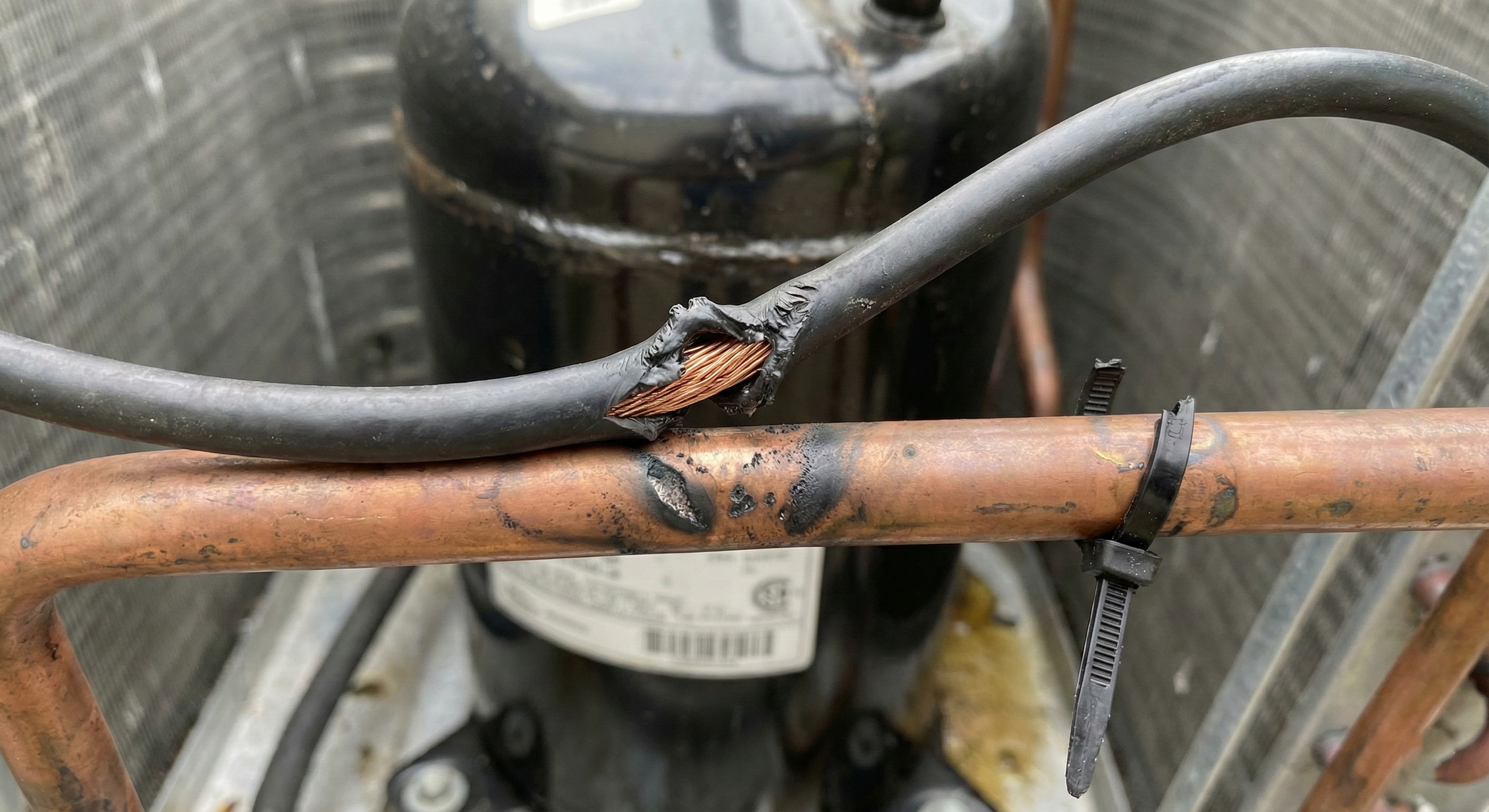
Close-up of an HVAC wiring issue showing exposed copper from a vibration rub-out, a common find during an HVAC troubleshoot for intermittent electrical failures
2. The Blower Housing
In the air handler or furnace, wires are often routed tightly around the sharp edges of the blower housing.
The Issue: As the blower motor ramps up (especially with ECM motors that vary speed), the torque can pull wires tight against sharp sheet metal.
The Fix: Check the low voltage bundle entering the blower compartment. These thin thermostat wires are easily sliced by sheet metal vibration.
3. Molex Plugs and Spade Connectors
A connection that looks tight might be electrically loose.
The Issue: "Pin Spread." Male pins on a circuit board or harness can spread the female socket in a Molex plug over time, creating a connection that only works when cold. As the current flows and the metal heats up, the connection expands and breaks.
The Fix: Don’t just look at the plug; tug on individual wires. If a wire pulls out of the back of a Molex plug effortlessly, the crimp was bad.
The "Wiggle Test": Simulating the Failure
Since the unit works while it's sitting still, you have to make it fail. This is where the "Wiggle Test" comes in.
Safety First: Ensure you are wearing proper PPE. This test is often done on live circuits to see if voltage drops out (care is required), or on de-energized circuits using continuity.
Hook Up Your Meter: Clip your leads to the component that is dropping out (e.g., the contactor coil or the pressure switch circuit).
Recreate the Vibration: With the system running (or powered off but with continuity toner attached), systematically grab bundles of wires and wiggle them aggressively. Shake the unit slightly.
Watch the Display: You aren’t listening for a beep; you are watching for the numbers to jump. If you wiggle a wire bundle and your 24V reading drops to 0V for a split second, you have found the location of the break or short.
Voltage Drop: The Ghost Hunter’s Best Weapon
Standard resistance (Ohms) testing lies to you on ghost calls. A wire with 90% of its strands broken will still beep for continuity, but it cannot carry the current needed to pull in a contactor.
Instead of testing resistance, test voltage drop under load.
Measure the voltage across a switch or wire connection while the system is trying to run.
If you read 0V across a closed switch, it’s good.
If you read 24V (or 240V) across a switch that is supposed to be closed, that switch is open or pitting.
If you read a "ghost" voltage like 6V or 12V across a connection, you have high resistance (corrosion or a loose crimp) that is eating up the voltage before it reaches the load.
Preventing Future Ghosts
The best way to handle wiring issues is to prevent them during installation or maintenance.
Nylon vs. UV Rated Zip Ties: Never use white nylon zip ties outdoors; they become brittle and snap within a year. Always use black UV-rated zip ties to secure wires away from copper lines.
Chafe Guards: If a wire must pass over a copper pipe or a sharp edge, wrap it in spiral wrap or a piece of split rubber hose.
Strain Relief: Ensure wires entering the cabinet have proper strain relief so vibration doesn't pull the connections apart at the board.
Summary
Intermittent electrical failures aren't magic; they are physics. They are the result of friction, heat, and vibration working against the system over time. By differentiating between a static short in the wall and a dynamic short in the unit, you can stop chasing ghosts. Don't just change the part, find the wire that killed it.