

Mastering HVAC Electrical Troubleshooting: The Professional Guide to Hopscotching
In high-volume residential and commercial service, the "Mean Time To Repair" (MTTR) is the metric that defines an elite technician. When a system is locked out, you aren't just looking for a broken part; you are tracing the sequence of operation to find exactly where the logic path terminates.
Among veteran techs and industry leaders, one method is the gold standard for speed and accuracy: The Hopscotching Technique.
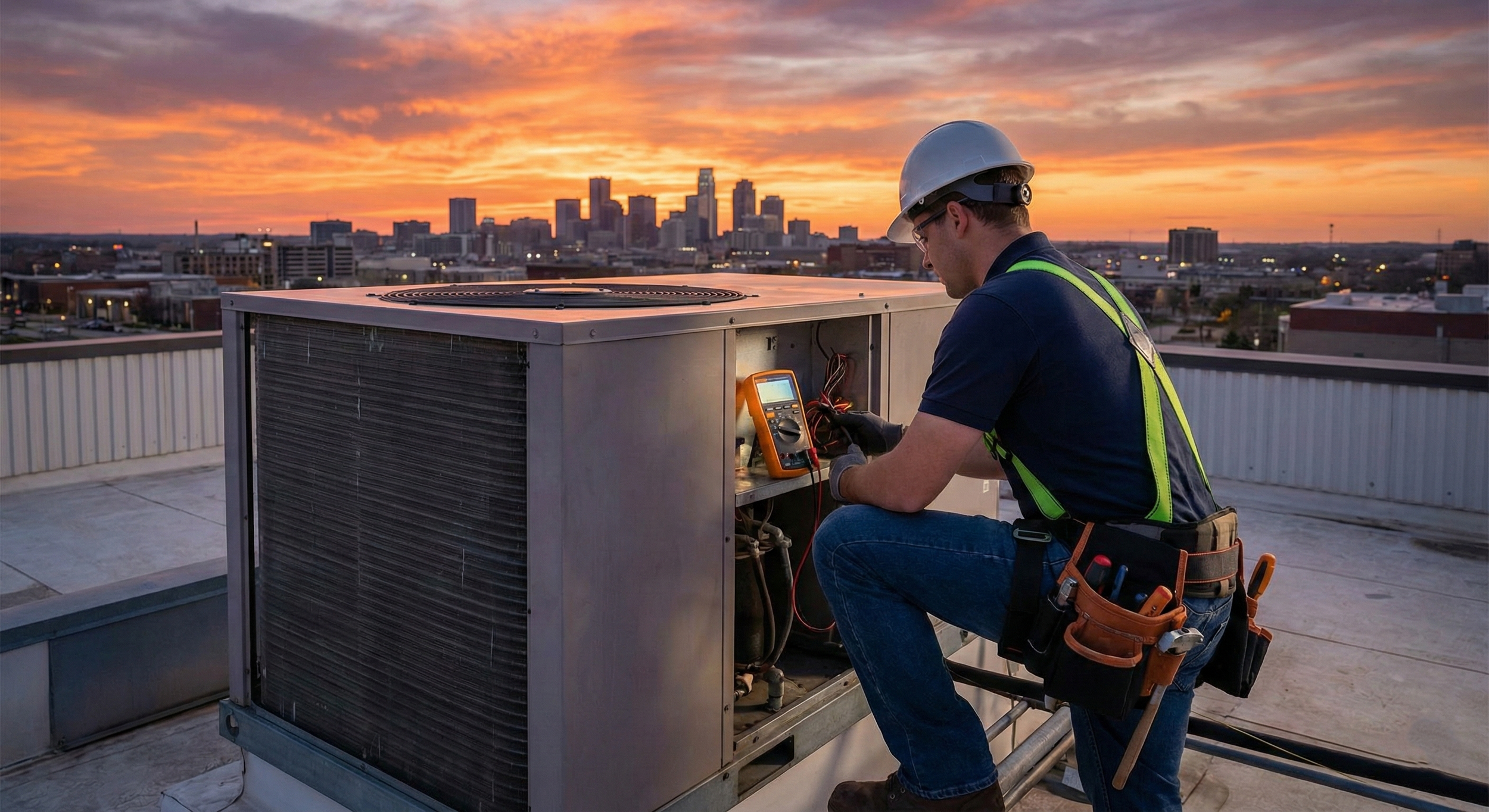
commercial technician performing hopscotch electrical troubleshooting on an commercial RTU
What is Hopscotching?
If you are troubleshooting a complex safety string on a furnace or a commercial RTU, checking across every individual switch is inefficient and can lead to "phantom voltage" errors.
Simply put, hopscotching is an electrical troubleshooting technique that works by establishing a single, constant reference point (Common) for one multimeter lead while "hopping" the other lead sequentially through the circuit’s safety and control components to identify where potential is lost.
The Professional Workflow for Electrical Troubleshooting
1. Establish a Reliable Common (The Anchor)
Your diagnosis is only as accurate as your reference point.
Low Voltage (24VAC): Secure your lead to the C-terminal of the transformer or the grounded chassis.
Line/High Voltage: Use a verified Neutral or Ground. Ensure your meter is CAT III or IV rated for the potential involved.
2. Verify Source Power
Before "hopping," you must confirm the source is providing the required potential. Measure from R to C. If you have 24V–28VAC, your source is solid. Attach your black lead to 'C' using an alligator clip and begin the sequence.
3. Sequential Logic Traversal
Follow the wiring schematic in the order of operations. A typical HVAC electrical troubleshooting path for a cooling call looks like this:
Transformer (R) → Thermostat Call (Y)
Thermostat → High Pressure Switch
High Pressure Switch → Low Pressure Switch
Low Pressure Switch → Contactor Coil
4. Performing the "Hop"
With your black lead fixed on Common, move your red lead to the "In" side of the first switch, then the "Out" side.
The Logic: If you have 24V on the "In" but 0V on the "Out," that switch is Open.
Hopscotching is an electrical troubleshooting technique that works by revealing the specific point where the potential energy stops, isolating the failure to a single component in seconds.
Technical Reference: Root Cause Analysis (RCA)
Finding the open switch is only 50% of the job. Professionals use the data from their electrical troubleshooting to perform a root cause analysis:
| Diagnostic Point | Status / Root Cause | |
|---|---|---|
| Source Power Verification | ||
| Transformer Primary | If 0V: Check Breaker or Disconnect | |
| Transformer Secondary (R) | If 0V: Transformer Failure or Internal Fuse | |
| The Hopscotching Sequence | ||
| Switch Input (Line Side) | Power Present at Component | |
| Switch Output (Load Side) | Switch Closed: PATH CLEAR | |
| Switch Output (Load Side) | FAULT: Switch is OPEN / Tripped | |
| Root Cause Analysis Matrix | ||
| High Pressure Switch | Dirty Condenser, Fan Failure, Overcharge | |
| Low Pressure Switch | Filter/Airflow, Low Charge, Failed TXV | |
| High Limit / Rollout | Blower Failure, Static Pressure, Heat Exchanger | |
Pro-Tips for Advanced Field Diagnostics
Use LoZ Mode: Modern digital meters can pick up induced "ghost" voltage in long wire runs. Use the LoZ (Low Impedance) function to bleed off these stray readings and ensure a true binary "Power/No Power" result.
The "One-Hand" Rule: Use a magnetic meter strap and alligator clips. Keeping one hand free is not just about efficiency—it is a critical safety practice when performing HVAC electrical troubleshooting on live equipment.
True RMS Matters: When troubleshooting around Variable Frequency Drives (VFDs) or ECMs, only a True RMS meter will provide accurate voltage readings amidst the electrical noise.
Conclusion
Mastering the hopscotching technique moves you from "guessing" to "knowing." It is the most reliable method for tracing faults in both residential furnaces and massive commercial chillers. By understanding that hopscotching is an electrical troubleshooting technique that works by isolating the break in the series string, you reduce callbacks and provide superior service.