

Top 10 Signs of Faulty Electrical Wiring in Your HVAC Unit
Top 10 Signs of Faulty Electrical Wiring in Your HVAC Unit
Your HVAC system is the heart of your home’s comfort, but it’s also a complex web of high-voltage components, relays, and circuits. When everything is running smoothly, we rarely give it a second thought. However, faulty wiring within the unit can lead to expensive repairs, system failure, or even dangerous electrical fires.
As experts in HVAC safety and efficiency, we know that catching a small HVAC issue early can save you thousands. While understanding the basic components—like capacitors, contactors, and transformers—is essential (as noted in curriculum from institutions like Erie Institute of Technology), you don’t need a degree to spot the red flags.
Here are the top 10 signs of faulty electrical wiring in your HVAC unit that you should never ignore.
1. Frequent Circuit Breaker Trips
Your circuit breaker acts as a safety guard, cutting power when the electrical load becomes too high. If your HVAC unit trips the breaker once, it might be a fluke. But if it happens repeatedly, you likely have a faulty wiring issue.
The Cause: This often signals a short circuit where a "hot" wire is touching a neutral wire or the ground, causing a surge of current. It could also indicate that the system is overworking due to a failing compressor, which draws more amps than the wiring can handle.
The Fix: Never simply tape the breaker "on." This is a major fire hazard. Call a professional to trace the short.
2. A Distinct Burning Smell
One of the most alarming signs of faulty electrical wiring is the scent of burning plastic or rubber near your air vents or the unit itself.
The Cause: This smell usually comes from the insulation on wires melting due to overheating. It can also result from loose connections causing electrical arcing (sparks jumping between gaps), which scorches the surrounding materials.
The Fix: Turn off your HVAC system immediately at the thermostat and the breaker panel to prevent a potential fire.
3. Dimming or Flickering Lights
Does the lighting in your home dim momentarily when your AC or furnace kicks on? While a very slight dim might happen in older homes with lower amperage service, significant flickering is a sign of bad wiring or an overloaded circuit.
The Cause: Your HVAC unit typically requires a dedicated circuit. If the wiring is loose, damaged, or insufficient (wrong gauge size), the unit will "starve" for power, pulling voltage away from other appliances and lights.
The Fix: You may need to upgrade your electrical panel or have an electrician inspect the capacitor, which helps the unit start up without draining the grid.
4. Buzzing or Humming Noises
Your HVAC system should hum gently, but loud buzzing or angry humming sounds are not normal.
The Cause: In electrical terms, a buzzing sound often points to a "contact" issue. A failing contactor relay (the switch that turns the high-voltage power on and off) can buzz if the internal coil is failing or if the connection is pitted and rough. Loose wires vibrating against metal casings can also create this noise.
The Fix: Listen to where the sound is coming from (the outdoor condenser or the indoor air handler) and report it to a technician.
5. Thermostat Malfunctions
Your thermostat is the brain of the operation, sending low-voltage signals to the control board. If the screen goes blank, the interface becomes unresponsive, or the unit refuses to turn on despite the settings, bad wiring could be the culprit.
The Cause: Frayed low-voltage wires (often running through walls) can break the communication loop between the thermostat and the furnace or AC.
The Fix: A technician can use a multimeter to test the continuity of the thermostat wires and locate the break.
6. Short Cycling (Turning On and Off Rapidly)
If your HVAC unit starts up, runs for a few minutes, and then shuts down only to restart shortly after, it is "short cycling."
The Cause: While this can be caused by dirty filters, it is frequently an HVAC issue related to the electrical system. A failing thermostat wire, a damaged flame sensor (in furnaces), or a fluctuating power supply caused by loose connections can trick the system into shutting down prematurely.
The Fix: This puts immense stress on the compressor and must be addressed immediately to avoid total system failure.
7. Visibly Damaged or Frayed Wiring
If you inspect your outdoor condenser unit and see wires that look chewed, cracked, or exposed, you have a clear confirmation of faulty wiring.
The Cause: Outdoor wiring is exposed to the elements and pests. Rodents often chew through wire insulation to sharpen their teeth, and UV rays can crack the protective coating over time.
The Fix: Never touch exposed wires. Even when the unit is off, capacitors can hold a lethal charge. Leave this repair to a certified pro.
8. Discolored or Scorched Components
If you open the access panel (after turning off the power!) and see brown or black soot marks on the control board or around wire terminals, you have evidence of electrical overheating.
The Cause: This is typically caused by a "high resistance" connection. When a screw terminal is loose, electricity struggles to jump the gap, generating intense heat that burns the connection point.
The Fix: A technician will need to replace the damaged wire and likely the component (like the contactor or capacitor) it was attached to.
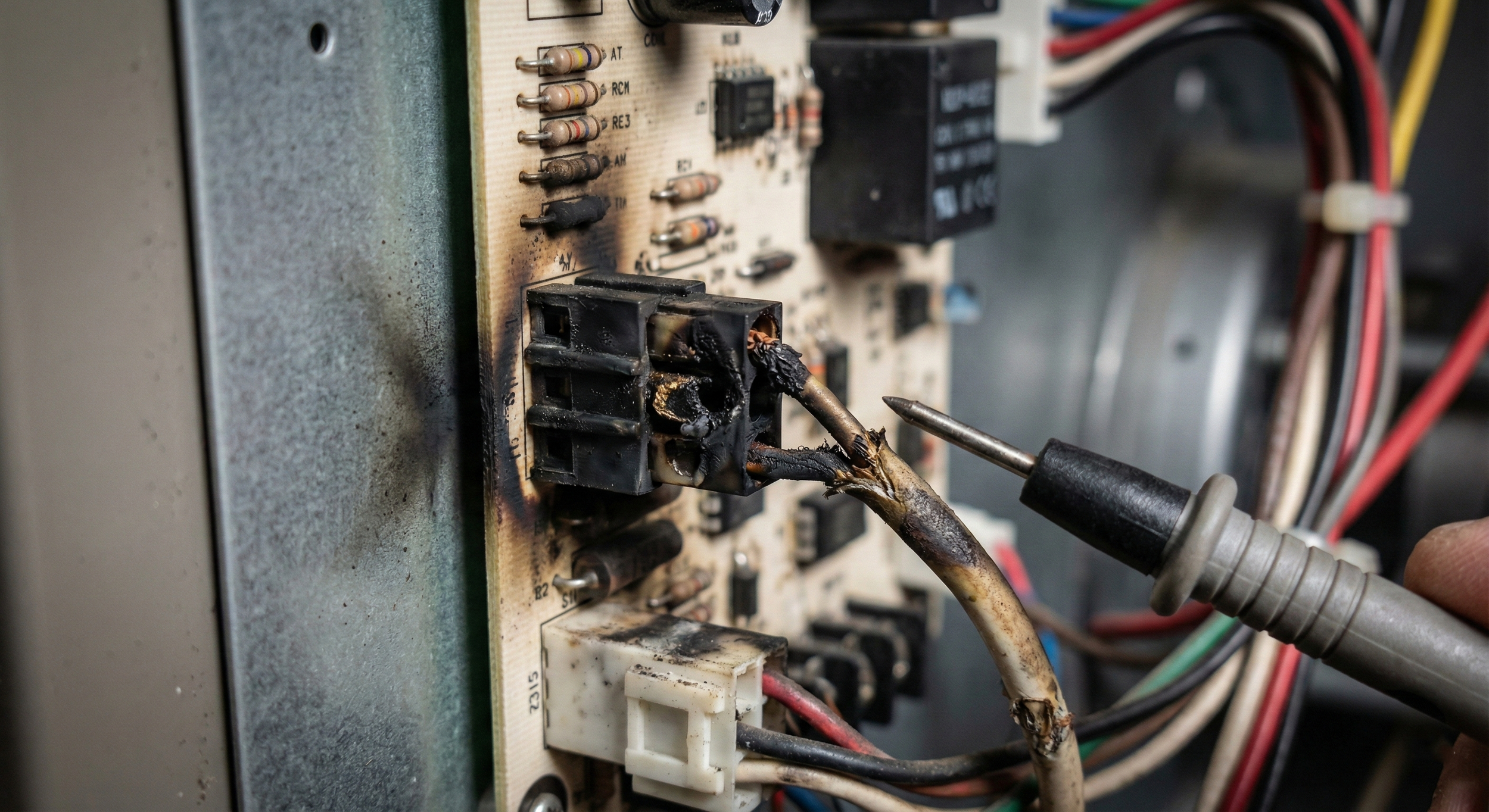
Burnt electrical connector caused by faulty electrical wiring on an HVAC control board being inspected with a multimeter probe
9. Ice Formation on the Evaporator Coil
While ice seems like a airflow problem, it can stem from electrical failures.
The Cause: If the blower motor wiring is faulty, the fan may not run at the proper speed (or at all). Without warm air blowing over the coils, the refrigerant gets too cold and freezes the humidity in the air, turning your unit into a block of ice.
The Fix: If the fan isn't spinning but the compressor is humming, it’s likely a capacitor or wiring issue.
10. Unexplained Increases in Energy Bills
Have your electric bills skyrocketed without a change in usage? Bad wiring makes your system work harder than it needs to.
The Cause: As wires degrade or connections loosen, resistance increases. Increased resistance creates heat and voltage drops, forcing the motor and compressor to draw more amps to do the same amount of work.
The Fix: Routine maintenance including an "amp draw" test can identify if your unit is pulling more electricity than the manufacturer's specifications.
Conclusion: Don't DIY High Voltage
Recognizing the signs of faulty electrical wiring is the first step in protecting your home. However, HVAC systems operate on high voltage (240V for most AC units) and contain components like capacitors that store energy even when unplugged.
If you notice any of these signs, do not attempt to fix them yourself. Contact a licensed HVAC professional who understands the intricate wiring and safety standards required to get your system back to #1 condition safely.