

Troubleshooting AC System Malfunctions: Dealing with Bad Wiring and Electrical Issues
There are few things more frustrating than a silent air conditioner on a sweltering day. When your cooling system fails, homeowners often fear the worst, a broken compressor. However, the issue is frequently not mechanical, but a hidden electrical malfunction.
Electrical problems are the silent killers of HVAC systems. Unlike a dirty filter that simply reduces airflow, bad wiring and electrical issues can cause permanent damage to your equipment or even pose a fire hazard.
In this guide, we will walk you through the essential steps for troubleshooting ac system electrical faults. We’ll cover the warning signs, how to inspect your system safely, and the technical differences between electrical trips that determine if you need a pro.
Safety First: The Golden Rule of Electrical Troubleshooting
Before we dive into the wires and breakers, we must address safety. Central air conditioners run on high-voltage electricity (usually 220-240 volts).
Never touch exposed wires while the power is on.
Always turn off the power at the main service panel (breaker box) and the disconnect box near the outdoor unit before inspecting internal components.
Warning: Capacitors (components inside your AC) can hold a dangerous electrical charge even after the power is cut.
4 Signs of an Impending Electrical Malfunction
Your AC usually gives you clues before it fails completely. According to safety experts at UL Solutions, you should never ignore sensory warning signs.
1. The Scent of Burning
If you smell burning plastic or a "fishy" odor near your vents or the outdoor unit, shut the system down immediately. This often indicates that wire insulation is melting due to overheating or bad wiring connections inside the unit.
2. Buzzing or Popping Sounds
Electricity should flow silently. If you hear a loud buzzing, humming (that isn't the fan), or popping noises, it often points to a loose wire creating an "arc" or a failing contactor switch. Apollo Home notes that these auditory cues are clear indicators of an electrical system malfunction that requires immediate attention.
3. Circuit Breakers That Keep Tripping (Thermal vs. Magnetic)
A tripping breaker is your home's way of screaming for help. To troubleshoot effectively, you need to understand how it tripped. As explained in technical breakdowns by Eaton, most modern AC breakers utilize a thermal-magnetic mechanism, meaning they can trip in two distinct ways:
Type A: The Thermal Trip (System Overload)
What it is: This happens when current slightly exceeds the breaker's limit over a period of time. A bimetallic strip inside the breaker heats up, bends, and eventually trips the latch.
The AC Context: This usually points to a mechanical strain. If your compressor is dying, your air filter is clogged, or your coils are dirty, the AC motor has to work harder. It draws slightly more amps than it should, slowly heating the breaker until it pops.
The Clue: The breaker feels hot to the touch, or it trips after the AC has been running for 5, 10, or 30 minutes.
Type B: The Magnetic Trip (Short Circuit)
What it is: This is an instantaneous reaction to a massive surge of current. An electromagnet inside the breaker pulls the trip lever immediately to prevent wires from melting or catching fire.
The AC Context: This confirms a severe electrical malfunction or bad wiring. It typically means two bare wires are touching (short to ground) or the compressor motor has internally seized.
The Clue: The breaker trips the millisecond the AC tries to start, often accompanied by a loud "pop" or flash inside the panel.
The Golden Rule: If you experience a Magnetic Trip (instant shut off), DO NOT attempt to reset it. This indicates a hard electrical fault that requires a professional HVAC technician immediately.
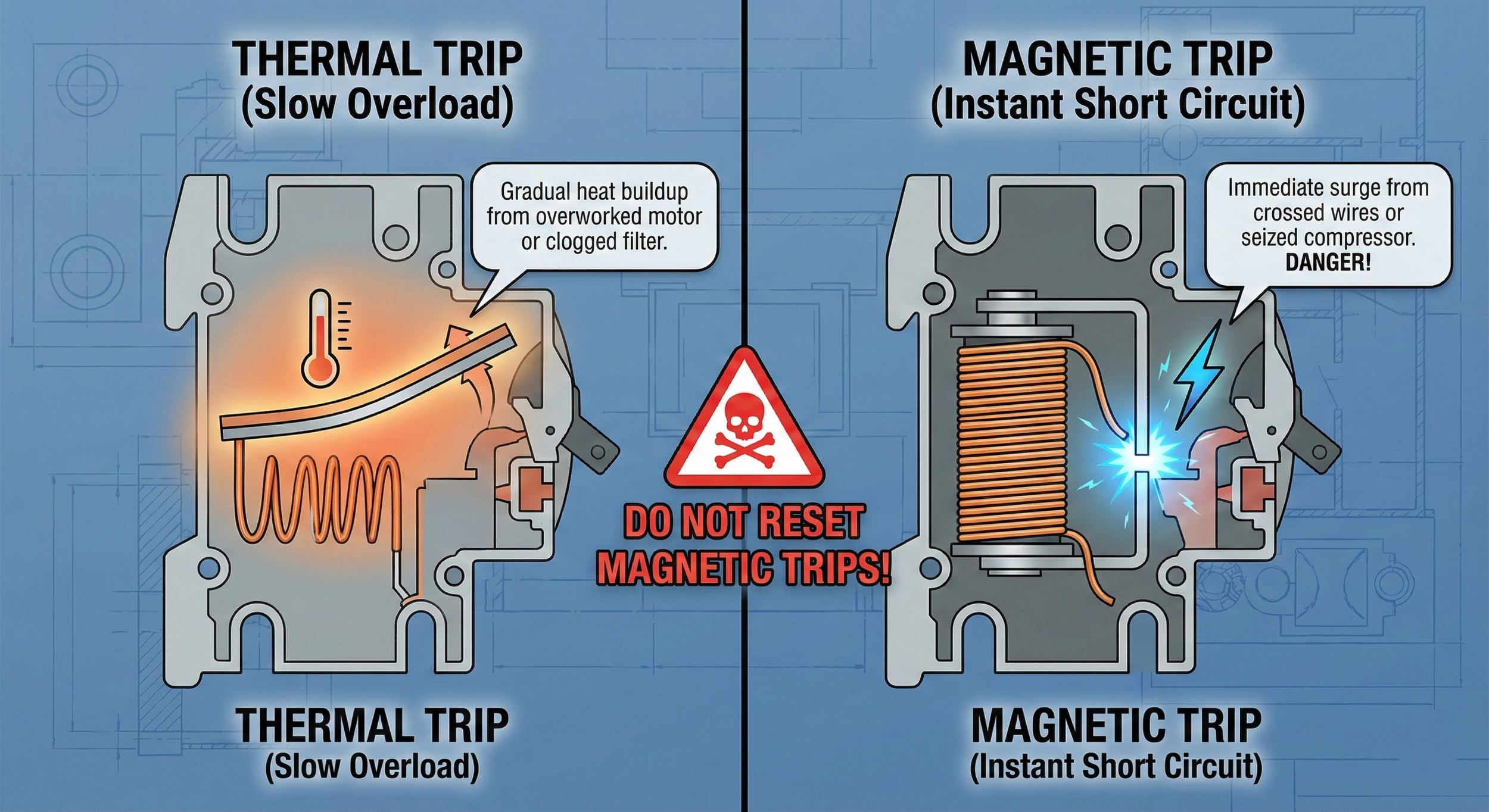
Diagram comparing the mechanics of a slow thermal overload trip versus an instant magnetic short circuit trip in an AC breaker
4. Hard Starts
Does your AC stutter or dim the lights in the house when it kicks on? This is a sign that the compressor is drawing significantly more power than it should, often due to a failing capacitor or loose electrical connections.
Common Electrical Issues in Central AC Systems
When troubleshooting ac system components, you are likely to encounter one of these three culprits.
Corroded or Loose Wiring
The Department of Energy highlights that wire and terminal corrosion is a frequent issue in many systems. Over time, vibration from the compressor can shake wires loose, while moisture can corrode terminals. A loose wire increases resistance, which generates heat and eventually melts the connection.
Failing Capacitors
Your AC unit uses a "start capacitor" to give the motor the torque it needs to spin up, and a "run capacitor" to keep it going. These are like small batteries. If a capacitor bulges or leaks oil, it can no longer store the energy required to start the compressor, leading to electrical issues where the fan spins but the compressor hums and shuts off.
Contactors Pitting
The contactor is the switch inside your outdoor unit that controls the flow of electricity to the compressor. Over thousands of cycles, the metal contacts can get pitted or burnt. A stuck contactor can keep your AC running continuously, while a pitted one might prevent it from turning on at all.
Step-by-Step: Troubleshooting Your AC’s Electrical System
If your system has stopped working, follow this sequence to identify the problem.
Step 1: Check the Thermostat
It sounds simple, but many calls for "broken" ACs are just thermostat issues.
Ensure the batteries are fresh.
Check that the display is on and set to "Cool."
Pro Tip: If the screen is blank even with new batteries, you may have a low-voltage wiring issue. The thin wires connecting your thermostat to the furnace/AC can break or short out.
Step 2: Inspect the Breaker Panel and Disconnect Box
Go to your main electrical panel. Is the breaker labeled "AC" or "HVAC" in the neutral or "Off" position?
Flip it firmly to "Off" and then back to "On" (only once!).
Check the outdoor disconnect box (the gray box mounted on the wall near your AC). Ensure the fuse block is inserted correctly and not melted.
Step 3: Visual Inspection of the Outdoor Unit
Turn off all power before doing this. Walk out to your condenser unit. Trane suggests looking for signs of physical damage.
Chewed Wires: Mice and squirrels often chew through the low-voltage wires extending from the house to the unit.
Debris: Sticks or leaves jamming the fan can cause the motor to over-amp and trip the electrical safety overload.
Step 4: Check the Air Filter
While not an electrical part, a clogged filter is a leading cause of electrical component failure. A dirty filter restricts airflow, causing the evaporator coil to freeze. This forces the compressor to work twice as hard, leading to overheating and tripped breakers. Replacing a dirty filter is the easiest fix for many system failures.
When to Call a Professional
While some troubleshooting ac system steps can be DIY, dealing with bad wiring and high-voltage internal components is best left to experts.
You should call a certified HVAC technician if:
The breaker trips immediately upon resetting (Magnetic Trip).
You see visible burn marks on the capacitor or contactor.
You are uncomfortable working with electricity.
The wiring looks brittle, black, or melted.
A Note on Refrigerant
Sometimes, what looks like an electrical issue (AC blowing warm air) is actually a refrigerant leak. As discussed in HVAC communities, if the fan and compressor are running (electrically sound) but the air is warm, the issue is likely a leak, which requires EPA-certified handling.
Summary
Dealing with electrical malfunction in your HVAC system requires patience and caution. By identifying the signs of bad wiring, like burning smells, buzzing sounds, and specifically the type of breaker trip occurring, you can catch small problems before they become expensive repairs. Start with the basics: check your filter, thermostat, and breakers. If the electrical issues go deeper than that, protect your safety and your home by calling in a professional.