

Bad Electrical Work in HVAC: Correcting Sloppy Wiring & Preventing Fire Hazards
We’ve all seen it. You walk up to a condenser or pull the panel off a furnace, and what greets you isn’t a clean schematic it’s a spaghetti monster. A chaotic explosion of tangled wires, excessive electrical tape, and wire nuts hanging on for dear life.
In the industry, we call this a "bird's nest," and it is the hallmark of bad electrical work.
While your system might technically "run" with sloppy wiring, it is a ticking time bomb. Unlike the electrical theory we cover in our diagnostic guides, this issue isn't about where the power goes, but how it gets there. Sloppy wiring leads to rub outs, short circuits, and, in worst-case scenarios, HVAC fires.
If you want to ensure longevity and safety, you have to move beyond just making it work, you have to make it right. Here is how to identify and correct the most common "wiiring" disasters in HVAC systems.
The "Bird's Nest": Why Neatness is a Safety Feature
Many homeowners, and even some rookie technicians mistake wire management for pure aesthetics. They assume that as long as the contactor pulls in, the job is done. This is a dangerous misconception.
Neat wiring is not just about looking professional; it is a critical safety feature. Here is why the "bird's nest" is a primary cause of HVAC problems:
Vibration and Rub outs: HVAC units vibrate constantly. If wires are left loose and tangled, they rub against copper tubing, sheet metal edges, or other components. Over time, this friction wears through the insulation, causing a direct short to ground.
Airflow Obstruction: In tight control boards or ECM motor compartments, a mass of tangled wires can actually block the cooling air required for electronic components, leading to premature board failure.
Impossible Diagnostics: When a system fails, a technician needs to trace circuits. If the unit is a rat's nest, tracing a simple 24v short becomes a three-hour nightmare, costing you significantly more in labor.
4 Signs of Bad Electrical Work in Your HVAC System
How do you know if your system was installed or repaired by someone cutting corners? Look for these red flags of bad electrical work.
1. The "Flying" Wire Nut
Wire nuts are designed to connect two or more wires securely. However, they should never be supporting the weight of the wire itself. In sloppy installations, you will often see wire nuts dangling in midair, pulled tight by the tension of the wires. This tension can slowly pull the connection apart, leading to arcing and sparking a major fire hazard.
2. Exposed Copper (The Shiner)
A "shiner" occurs when too much insulation is stripped off the wire, leaving bare copper visible outside the terminal block or wire nut. This is a rookie mistake. That exposed copper is live voltage waiting to touch a grounded cabinet or a technician's screwdriver.
3. Bypassed Safeties
This is the cardinal sin of HVAC electrical work. If you see a wire jumping across two terminals on a high-pressure switch or a limit switch, someone has bypassed a safety device to force the unit to run. This doesn't fix the problem; it removes the only thing stopping your unit from destroying itself or causing a fire.
4. Daisy-Chained Capacitors
Instead of replacing a dual capacitor with the correct part, lazy technicians sometimes wire multiple capacitors together in a clumsy chain to get the desired microfarads. While electrically possible in an emergency, leaving this as a permanent fix is messy, unreliable, and prone to failure.
The Anatomy of a Fire Hazard: Loose Connections
According to data referenced by safety organizations like UL, electrical malfunctions are a leading cause of residential fires. In HVAC, the culprit is rarely the equipment itself, but rather the connections.
Aluminum vs. Copper: Older homes may have aluminum wiring. If your HVAC unit was connected to aluminum wiring without the proper anti-oxidant paste or rated connectors, thermal expansion will loosen that connection over time.
The Thermal Cycle: As your AC starts and stops, wires heat up and cool down. This expansion and contraction can loosen screws on the contactor or terminal block. If the initial installation was sloppy (hand tightened rather than torqued), the connection becomes loose. A loose connection increases resistance, which increases heat, which melts insulation. eventually leading to an arc fault and fire.
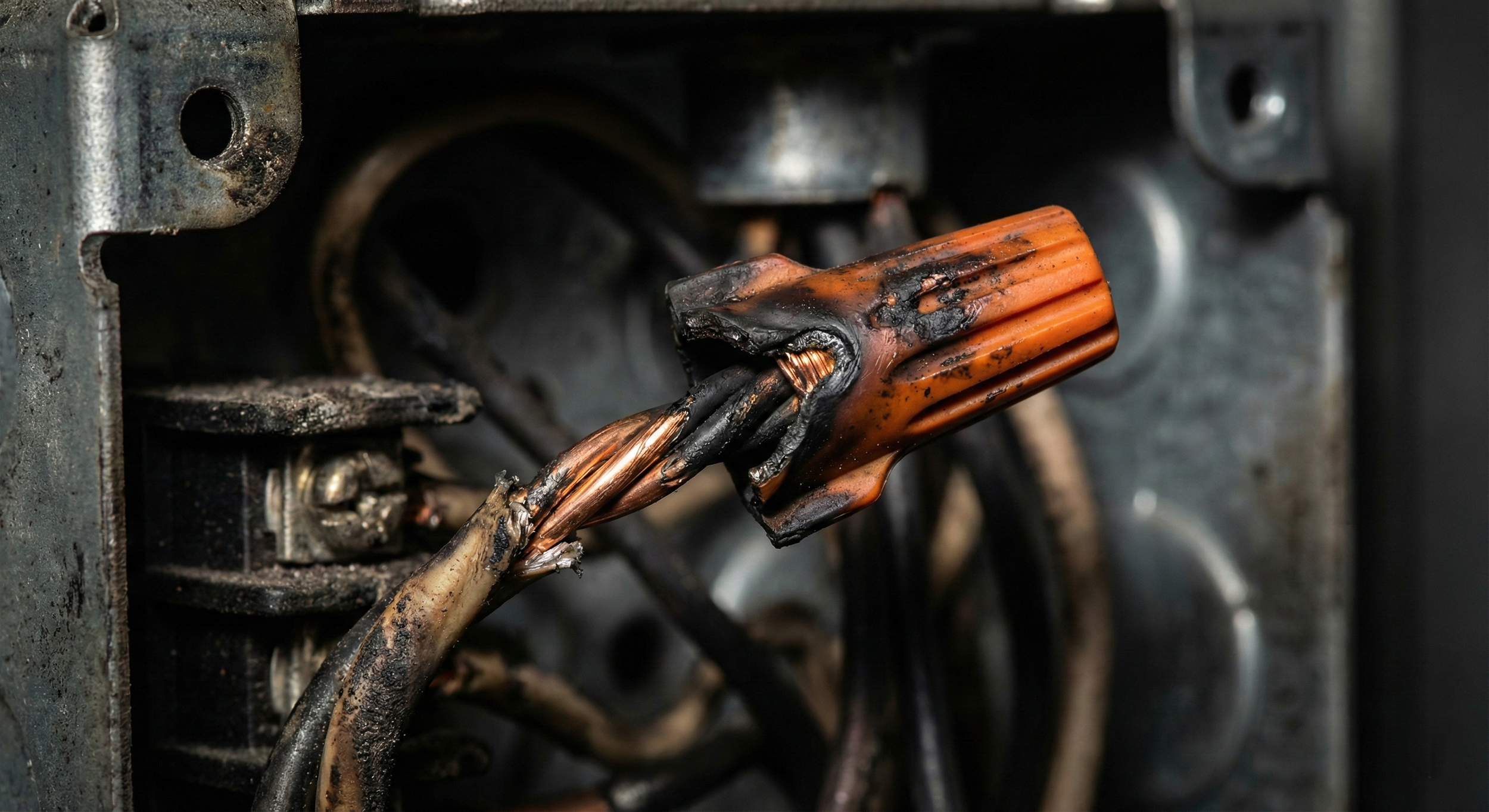
Close-up of a melted wire nut and exposed copper caused by bad electrical work and sloppy wiring
Correcting the Mess: Best Practices for Wiring Repairs
If you open your HVAC panel and see a mess, it’s time to clean it up. Whether you are a DIYer assessing your system or a tech looking to improve, here are the rules for correcting sloppy work.
1. Use Zip Ties (But Don't Strangle It)
Zip ties are your best friend for organizing wires into clean harnesses. However, do not pull them so tight that they crush the wire insulation. This creates a weak point where the wire can break internally.
2. Service Loops are Mandatory
Never stretch a wire tight to reach a component. Always leave a service loop, a small amount of slack folded neatly. This prevents tension on the terminal if the component vibrates or needs to be moved slightly for service.
3. Isolate High and Low Voltage
Standard HVAC wiring protocol dictates that low voltage (24v thermostat wiring) and high voltage (120v/240v) should be separated whenever possible. Running them parallel and touching for long distances can induce "ghost voltage" or interference in the low-voltage lines, causing erratic system behavior.
4. Re-Torque Your Lugs
Every year during maintenance, check the lugs on your contactor and disconnect box. Note: Ensure all power is OFF at the breaker before touching any terminals. A simple quarter-turn on a loose screw can prevent a melted compressor plug later in the summer.
When to Call a Pro
While identifying a "bird's nest" is easy, fixing it requires working with lethal voltage. If you notice melted wire nuts, the smell of burning plastic, or a buzzing sound coming from your breaker box or disconnect, these are immediate signs of bad electrical work that has crossed the line into dangerous territory.
Don’t let a sloppy installation compromise your home’s safety. If your wiring looks like a spaghetti dinner, it’s time to bring in a professional who understands that in HVAC, neatness isn't just about pride, it's about protection.